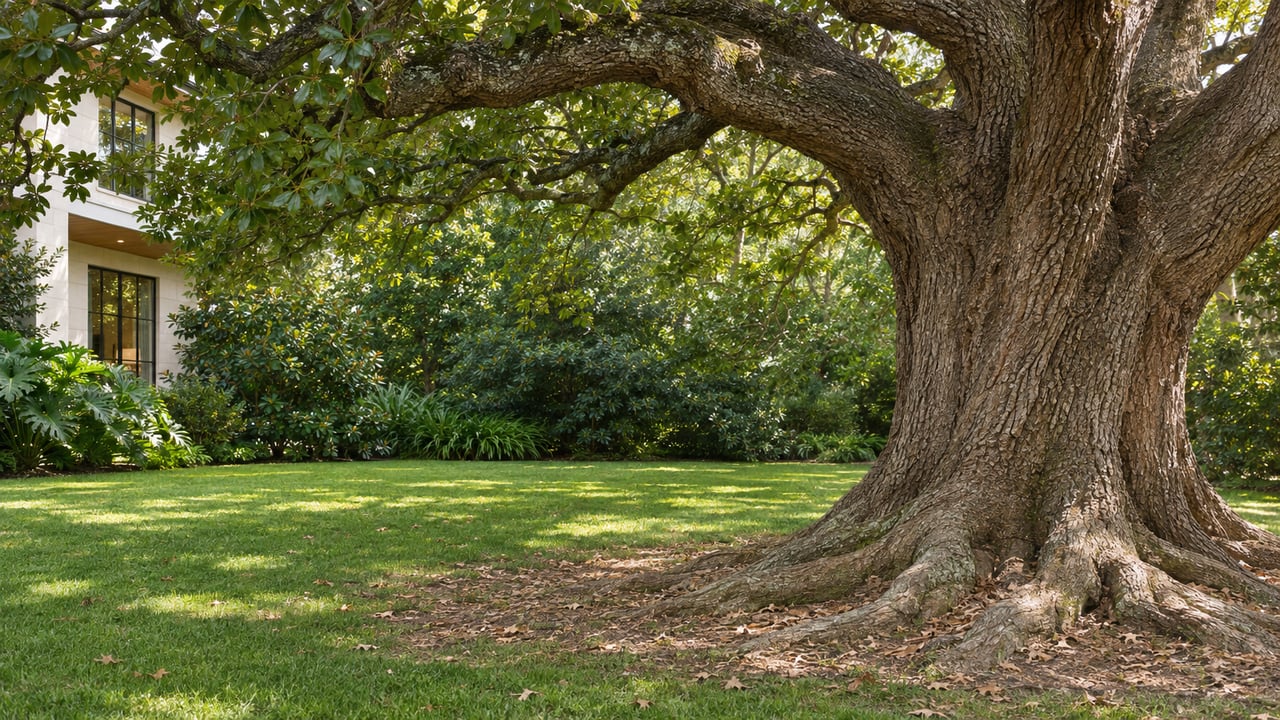
When an older house in West University Place is torn down, what shapes where the new slab goes? The setbacks, the 80% framed-area limit and the height rules all play a part. For a particular lot, how might the root zone of a large oak affect plans for raising the ground, and what should be checked with the city or project professionals? New West U homes are designed around drainage and elevation.
The city's criteria manual for its urban forest requires that at least 75% of a preserved tree's critical root zone stay at natural grade, with natural ground cover. Inside that preserved area, no cut or fill can be deeper than two inches. West U's New Home and Additions packet asks for two sets of drainage plans with base-level certifications. It also measures building height from the standard base-level elevation and requires a separate permit for any grade raising not shown on the original plans.
The critical root zone
The manual defines the critical root zone as a circle around the trunk. Its diameter is one-half the sum of the broadest and narrowest dripline diameters.
The manual adds some practical points that matter for a rebuild:
- Old slabs and roots. A tree that grew next to a house on a slab usually has fewer significant roots under the slab.
- Root depth. Most important roots are shallower than three feet.
- Crowns have a limit too. No more than 30% of the viable crown may be removed. The manual points out that a wall might take 30% and the scaffolding to build it might take another 20%.
The manual also ranks trees, scoring each one on ten factors for a total of up to 40 points. The factors include condition, species, size, shade, safety and whether neighboring trees surround it. Trees scoring 30 or more should be preserved if at all possible.
What changed in March 2026
The ground rules got stricter this spring. Community Impact reported that West University Place City Council voted 3-2 on March 9 to revise the tree ordinance. The revision measures trees by diameter instead of circumference, clarifies which trees are protected, and raises penalties. Public Works Director Michael Leech told Community Impact that "circumference can be challenging to explain to homeowners at times, so diameter is a little more straightforward."
On March 23, 2026, Council adopted Ordinance 3105 on second and final reading by the same 3-2 margin. Mayor Sample, Mayor Pro Tem Barnes and Councilmember Bertini voted aye, and Councilmembers Brett and Rainsberger voted nay. Three provisions in the ordinance text in the March 9 agenda packet matter most for a teardown:
| Provision | What the ordinance text says |
|---|---|
| Large tree | Presumed large if the stump diameter is six inches or greater |
| Protected tree on a development site | All large trees on a site with a development permit |
| Penalty | Misdemeanor, up to $2,000 per offense, in addition to replacement inches |
The revision also defines limbs that overhang any part of a right-of-way as a public nuisance. Craig Koehl, the city's urban forestry consultant, told Community Impact this gives the city authority to remove dead, hazardous trees in the right-of-way in front of homes.
Tree review and construction
Ordinance 3105 addresses tree surveys, tree-disposition conditions and protection of trees during demolition and construction.
How might a neighbor's oak affect a lot when its trunk sits across the property line? For narrow West U lots, the city or project professionals can assess whether a protected root zone affects plans for dumpsters, material deliveries and crew parking.
The manual recommends a preliminary meeting with the City Urban Forester before plans are submitted whenever trees and the design appear to conflict.
What a removed tree costs
When a large or protected tree comes out, the ordinance normally requires new trees planted on the same site to make up the required "replacement inches" under the criteria manual. The manual ties the number of replacement inches to the removed tree's valuation and size.
These are the tree-related fees in the city's FY2026 Master Fee Schedule:
| Fee | FY2026 amount | Applies to |
|---|---|---|
| Survey and disposition review, major construction | $250 | New construction, including residential, pools, major additions |
| Survey and disposition review, minor construction | $150 | Demolitions, garages, alterations, renovations |
| Removal permit | $100 | No fee for dead, dying or diseased trees |
| Replacement planting fee | $250 per caliper inch | When planting on site is not an option |
For comparison, the same schedule sets the single-family new-construction permit at $1.25 per square foot and the demolition permit at $250. Review fees are small. Replacement inches can add up.
This post is general information, not legal, tax or financial advice. Confirm the requirements for your lot with the City of West University Place and the appropriate professionals before you commit to a purchase or a design.
If you are weighing a West U teardown, Jaime Fallon and the Modern Houston development team can walk the lot with you before you make an offer. Request a complimentary consultation and home valuation to get started.